A Step-by-Step Guide to Custom Home Theater Design
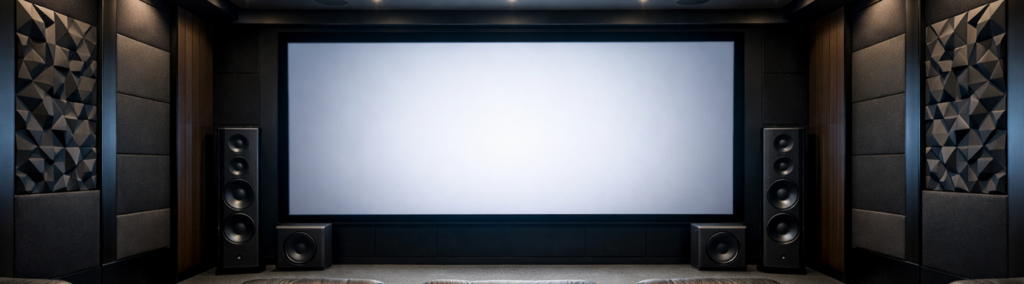
Key Takeaway
- Room selection is an important factor in home theater performance.
- Acoustic treatment is a technical science. Getting it wrong means investing thousands in equipment that never sounds its best.
Imagine sinking into your seat as the room goes dark, the screen fills your field of vision, and the sound wraps around you like you’re sitting in the middle of the scene. That’s what a well-designed home theater feels like. But getting there is not as simple as picking out a big screen and a nice speaker set.
Custom home theater design is one of the most technically complex projects a homeowner can take on. Every step, from which room you choose to how you wire the electrical, affects the final experience. Get one step wrong, and you can spend tens of thousands of dollars on equipment that never lives up to its potential.
If you’re building a custom home in Martin County or anywhere on Florida’s Treasure Coast, this guide walks you through every step of the process. And it shows you exactly why each stage is best handled by experienced professionals who understand both construction and technology.
Step 1: Which Room Should You Choose for Your Home Theater
The first and most consequential decision you’ll make is room selection. Many homeowners assume any large, spare room will do. In reality, room geometry, position within the home, and construction type all have a direct effect on sound quality and viewing performance.
Rectangular rooms are generally preferred over square ones because square rooms create standing waves. Specific frequencies that bounce between parallel walls and cause uneven bass response. The aspect ratio of your room matters. A room roughly 1.0 wide by 1.6 long by 1.0 tall is considered close to ideal by acoustic engineers.
Location in the home is equally important. Rooms adjacent to garages, laundry areas, or heavily trafficked living spaces introduce noise that undermines even the best audio systems. Rooms below grade like finished basements. Offer natural sound isolation but require careful moisture planning, which is especially relevant in Florida’s humid climate.
Choosing the wrong room means every subsequent investment is compromised. A professional builder with home theater experience evaluates your floor plan early in the design phase, identifies the best candidate rooms, and flags potential acoustic or structural issues before construction begins. At Masterpiece Builders, we incorporate home theater planning into the broader custom home design process so your theater room is built right from the ground up.
Step 2: How Do Acoustics Actually Work and Why Do They Matter So Much
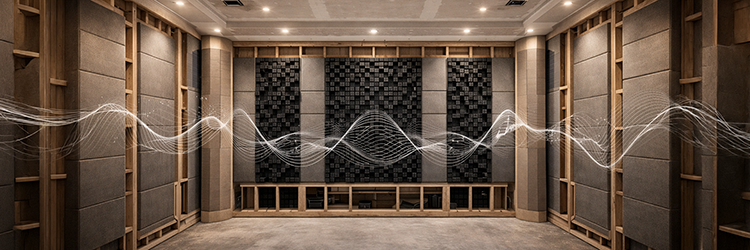
Acoustics is the science of how sound behaves in an enclosed space. In a home theater, it determines whether dialogue sounds crisp, whether music sounds rich, and whether explosions sound like movie magic or like noise from a bad speaker.
Sound waves reflect off hard surfaces and are absorbed by soft ones. An untreated room creates too many reflections called reverb, which muddies the sound and makes it feel like you’re listening in a bathroom. Over-treated rooms can sound dead and lifeless. The goal is a controlled balance.
There are three primary acoustic challenges in a home theater:
- Reverberation time – how long it takes the sound to decay after a source stops
- Bass buildup – low frequencies that accumulate in corners and along walls
- Flutter echo – rapid back-and-forth reflections between parallel hard surfaces
Each of these is addressed with a combination of absorptive materials (acoustic panels, thick drapes, plush seating), diffusion elements (varied surface textures and angles), and bass traps placed strategically in room corners.
Step 3: What Screen Size and Projection Setup Is Right for Your Space
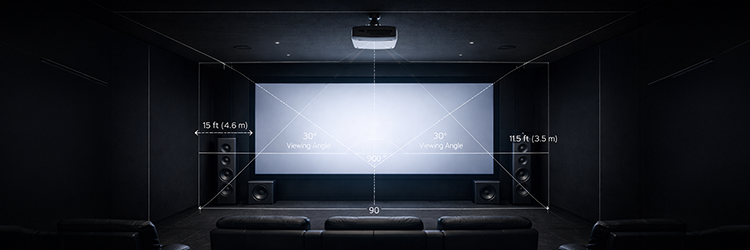
This is where the excitement really builds, but also where some of the most common mistakes happen. Screen size is not simply a matter of preference. It is a mathematical relationship between screen width, viewing distance, and resolution.
THX suggests up to 36 degrees for front-row seating. At a distance of 12 feet, that translates to a screen width of roughly 90 to 110 inches.
If your projector’s throw ratio does not match the distance from the lens to the screen, your image will be too small, too large, or simply unfocused. Short-throw projectors, long-throw projectors, and lens-shift capabilities all affect where your projector must be placed, which in turn affects ceiling height requirements and structural mounting needs.
Then there’s the choice between a traditional projector-and-screen setup and a direct-view display like a large LED or MicroLED panel. Each has different light requirements, installation demands, and performance characteristics in various ambient light conditions.
Step 4: How Should You Design Your Seating Layout
Seating is where the theater experience is actually delivered. A beautiful room with poor seating placement is like a great restaurant with uncomfortable chairs; the core experience suffers.
The primary seating row should ideally be positioned at the distance recommended by your chosen display standard. If you have multiple rows, each must be elevated to maintain clear sightlines to the screen, a detail called rake. The industry standard for home theaters is approximately 3 to 4 inches of elevation per row.
The number of seats, their width, and the aisle clearance requirements also determine the minimum room width needed. A double-wide riser with four seats per row requires a room that is at least 17 to 18 feet wide to feel comfortable and accessible.
Seating also affects acoustics. Plush, upholstered seats absorb sound and contribute to the room’s overall acoustic balance. Leather seating, while elegant, is more reflective and may require additional acoustic panels to compensate.
Step 5: What Lighting Plan Does a Home Theater Actually Need
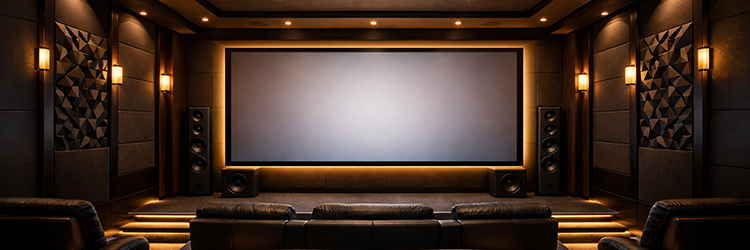
Lighting in a home theater serves three very different purposes: creating the right ambiance during viewing, providing safe navigation in a darkened room, and allowing functional lighting for cleaning, maintenance, and pre-show setup.
Ambient bias lighting – soft LED strips placed behind the screen. Reduces eye strain by softening the contrast between the bright screen and the dark room. Research published in various display science journals suggests that bias lighting can reduce eye fatigue during long viewing sessions by up to 50 percent compared to watching in complete darkness.
Aisle lighting keeps floor paths visible without washing out the image. Step lighting on risers is both a safety requirement and a design feature. Ceiling and wall sconces on dimmer control give you the ability to shift from full work lighting to pre-show glow to complete blackout with the press of a button.
The lighting control system itself, whether you use a dedicated smart home controller or a simpler dimmer system, must be specified and wired before walls are closed. Retrofit wiring is never as clean or reliable as planned infrastructure.
Step 6: How Do You Choose and Install the Right Audio and Video Equipment
Equipment selection is where the home theater dream comes to life, but only if the room is built to support it. Every component in your AV system must work together: the AV receiver, the speaker system, the display, the streaming and media sources, and the control system.
A 7.1.4 surround sound system, for example, includes seven channel speakers, one subwoofer, and four ceiling-mounted Dolby Atmos height speakers. Each of those ceiling speakers requires a structural mounting location, a conduit run to the AV rack, and a port in your acoustic ceiling treatment. None of that can happen without pre-planned infrastructure.
Speaker placement follows strict guidelines. Center channel alignment with the screen, side surround positioning at 90 to 110 degrees from the listening position, rear surrounds at 135 to 150 degrees, and Atmos speakers directly overhead. All of these are calculated positions.
Beyond the speakers, your AV rack (typically in a dedicated equipment closet for heat management) must be ventilated, organized, and accessible. Equipment generates significant heat, and in a Florida climate, rack ventilation is a real concern.
Step 7: How Do You Bring It All Together Without Going Over Budget
The final step is integration. Bringing every system together into a cohesive, functional, and beautiful experience. This means connecting your lighting control to your AV system so that dimming the lights and starting a movie happen with one touch. It means programming your smart home interface to recognize ‘Movie Mode’ versus ‘Intermission.’ It means integrating your streaming sources, your 4K Blu-ray player, your gaming console, and your security camera feeds into a single, intuitive control system.
Budget management across this entire project is genuinely complex. Home theater costs in Florida typically range from $20,000 for a modest dedicated room with mid-range equipment to well over $150,000 for a fully custom, cinema-grade build with premium finishes. Scope creep is common when homeowners add features incrementally without seeing the full picture upfront.
A detailed project budget, developed at the beginning of the design process with accurate material costs and labor estimates, is the only way to build a home theater that delivers the experience you envisioned without financial surprises along the way.
Final Takeaway
- The biggest home theater mistakes happen in the planning phase. Invest in professional design first.
- Every step of the process, including acoustics, screen placement, lighting, and wiring, has a construction implication that must be resolved before walls are closed.
- Florida’s climate adds unique considerations: humidity for below-grade rooms, heat management for AV equipment, and storm-resilient construction details matter in Martin County.
Ready to start designing your custom home theater in Martin County? Contact Masterpiece Builders today for a consultation, and let’s build something extraordinary together.