
The short answer: Verify the license class, not just that a license exists. Ask how the builder handles your budget before design starts. See finished work in homes like yours, talk to past clients, and get specifics on communication, selections and change orders in writing. A builder who welcomes these questions is usually the one you want.
We are a builder, so read this with that in mind. These are the same checks we would want our own family to make, and none of them require you to take anyone’s word for it.
1. Check the license class, not just the license
Every Florida contractor license can be looked up on the Florida Department of Business and Professional Regulation’s license search at myfloridalicense.com. Look at the classification, because it defines what the contractor can legally build:
- Certified General Contractor (CGC): services are unlimited as to the type of work.
- Certified Building Contractor (CBC): limited to buildings that do not exceed three stories.
- Certified Residential Contractor (CRC): limited to one, two or three family homes of no more than two habitable stories above no more than one uninhabitable story.
Match the license to your project. A three-story waterfront home, a home with habitable space over a garage level, or a project that mixes residential and commercial work may fall outside some license classes. Also confirm the license is active and check for any disciplinary history. Masterpiece operates under Florida Certified General Contractor license CGC 048543.
2. Ask how they handle your budget before design starts
This is the question that matters most, and the one people skip.
Years ago, a homeowner came to us holding a beautiful set of plans and a heavy heart. The design was a $900,000 build. Her budget was $600,000. No one had ever asked her what she could spend. We never forgot it, and it is why our process puts the budget in the room on day one.
Ask any builder: at what point do you price the design, and what happens if the design comes in over budget? You want a builder who designs to a number, not one who prices a finished design and hopes.
3. Find out who designs and who builds
In a traditional arrangement, you hire an architect, then take the plans out to bid, and the builder you choose inherits a design they did not create. In a design/build arrangement, one team is accountable from concept to completion.
Neither model is wrong. But ask directly: if something in the drawings does not work in the field, who is responsible for fixing it, and who pays?
4. Ask when selections get locked
Allowances are where budgets drift. If your contract carries a vague allowance for cabinets or lighting, the real number shows up months later.
We lock the Big Five selections early: cabinetry, flooring, lighting, appliances and plumbing fixtures. That way the price you see before permits reflects what you actually chose. Ask any builder which selections are fixed at contract and which are still allowances.
5. See finished work in homes like yours
A portfolio shows photography. A walkthrough shows craftsmanship. Ask to see a completed home, or at least a home under construction, similar to yours in size, style and setting.
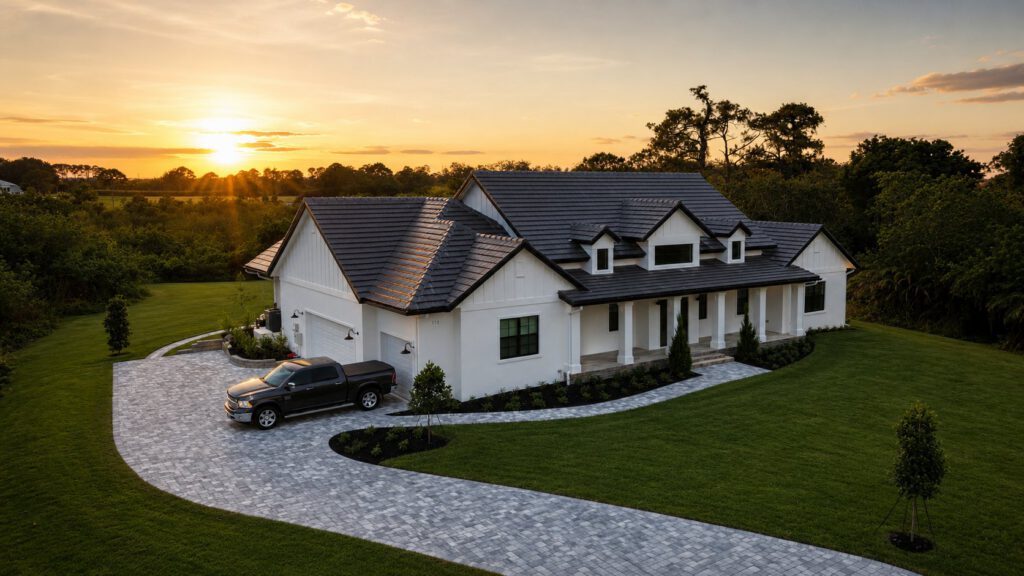
Setting matters on the Treasure Coast. An oceanfront home on Hutchinson Island, a riverfront home in Sewall’s Point and an estate in Palm City each carry different permitting, wind and flood considerations. Ask how many homes the builder has completed in your community and which building department they work with most often.
6. Talk to past clients, including one from years ago
Recent clients tell you about the process. A client whose home was finished five or ten years ago tells you how the house has held up and whether the builder still picks up the phone.
One of our clients in Martin County put it this way: “The design is magnificent, the workmanship is impeccable, and Masterpiece Design/Build has been 100% responsive to all of our questions, needs, and requests.” Ask every builder for references you can call, not just quotes on a website.
7. Get the communication plan in writing
The hardest part of building today is coordinating time and people. Ask:
- Who is my day-to-day contact?
- How often will I get updates, and in what form?
- How are change orders priced and approved?
- How will I know what has been paid, and to whom?
On payments, ask how the builder handles lien releases from subcontractors and suppliers under Florida’s construction lien law. A good builder will explain it without being asked twice.

8. Ask about the code change and flood rules
The 9th Edition Florida Building Code takes effect December 31, 2026, and flood zone rules can reshape a renovation or rebuild. A builder working in Martin County should be able to explain both in plain language. See our guides to the 2026 code change and the 50% rule.
Frequently asked questions
How do I verify a contractor’s license in Florida?
Use the Florida DBPR license search at myfloridalicense.com. Search by name or license number and check the classification, status and any public complaints.
What is the difference between a CGC and a CRC license?
A Certified General Contractor’s scope is unlimited as to type of work. A Certified Residential Contractor is limited to one, two or three family residences of no more than two habitable stories above no more than one uninhabitable story.
Is design/build more expensive?
Not inherently. Its advantage is that budget and design are managed together, which reduces the risk of designing a home you cannot afford to build.
How many builders should I interview?
Most homeowners are well served by meeting two or three builders who work regularly in their area and price range.
What should I bring to a first meeting?
Your lot information or survey if you have one, a realistic budget range, a list of must-haves, and photos of homes you like.
Meet us the same way
Masterpiece Design/Build is family owned and has built and renewed more than 1,000 homes on the Treasure Coast since 1988. Run us through every check on this list. Book a consultation and we will show you finished work, put you in touch with past clients, and talk honestly about your budget from the first meeting.